Showing posts with label Buffalo. Show all posts

Tuesday, September 11, 2012

Remembering 9/11/2001

They Were Our Neighbors
 -

by Dawn Colclasure

They were our neighbors,


Someone to whom we'd just say "hi."


Never did we ever think


The next day they would die.


We never took one last long look


Or gave an extra smile.


The attacks on September 11


Taught us to go that extra mile.


We'll never be able to hug them again


But now we can hug others.


And say an extra "I love you"


To our children, friends and mothers.

We miss our neighbors every day


And wish they were not gone.


But we'll cherish those that are still here


While we will move on.


The local Red Cross in Buffalo put out 2,917
flags in memory of those who died.

Today is the 11th anniversary of 9/11 -

we will never forget.

photos by peacesojourner


Saturday, June 16, 2012

Juneteenth - Freedom Day


Juneteenth, also known as Freedom Day or Emancipation Day, is a holiday honoring African-American heritage and commemorates the announcement of the abolition of slavery in the state of Texas in 1865.

Celebrated on June 19, the term is a combination of June and nineteenth, and is recognized as a state holiday in 36 states.

The holiday originated in Galveston, Texas; for more than a century, the state of Texas was the primary home of Juneteenth celebrations, and since 1980, Juneteenth has been an official state holiday in Texas History

Though President Abraham Lincoln issued the Emancipation Proclamation on September 22, 1862, with an effective date of January 1, 1863. It had minimal immediate effect on most slaves’ day-to-day lives, particularly in Texas. Texas was resistant to the Emancipation Proclamation, and though slavery was very prevalent in East Texas, it was not as common in the Western areas of Texas, particularly the Hill Country, where most German-Americans were opposed to the practice.

Juneteenth commemorates June 18 and 19, 1865. June 18 is the day Union General Gordon Granger and 2,000 federal troops arrived inGalveston, Texas, to take possession of the state and enforce the emancipation of its slaves. On June 19, 1865, Granger read the following declaration:

‘The people of Texas are informed that, in accordance with a proclamation from the Executive of the United States, all slaves are free. This involves an absolute equality of personal rights and rights of property between former masters and slaves, and the connection heretofore existing between them becomes that between employer and hired labor. The freedmen are advised to remain quietly at their present homes and work for wages. They are informed that they will not be allowed to collect at military posts and that they will not be supported in idleness either there or elsewhere.’

On June 19, 1865, in Galveston, Texas, the newly freed slaves held large public celebrations and so the tradition was started to celebrate future Juneteenth activities.

Here, in Buffalo, NY the celebration of Juneteenth is held for two days every June. This year it is today and tomorrow (June 16th and 17th). It starts with a colorful, joyful parade. Thousands of people attend the event in MLK Park, which has music, plenty of good food, vendors selling African jewelry and clothing. There are booths from many local agencies such as the NAACP, Urban League, Health Services. The tradition is an important part of local history and enjoyed by all that attend.

peacesojourner

Thursday, June 14, 2012

Flag Day - June 14, 2012


There are a few variations on the history of Flag Day in the United States. Here is the version that is taught here in Buffalo NY.

Sarah Hinson was born in Buffalo on February 25, 1841, the daughter of Squire and Mrs. George Hinson. Sarah was educated in the Buffalo School System, and at a private finishing school.

She began teaching in Buffalo When she was 23, in 1864, Miss Hinson transferred to School 31 on Emslie Street where she spent nearly fifty years, thirty as a teacher before becoming the school principal.

Ms. Hinson began Flag Day exercises, by teaching the children to salute the Flag and repeat the Pledge of Allegiance, to instill in her pupils a proper respect for the nation's flag. She held the first ceremony in 1891 on June 14 because that was the date, in 1777, that the Continental Congress replaced the British symbols of the Grand Union flag with a new design featuring 13 white stars in a circle on a field of blue and 13 red and white stripes – one for each state.

The following year, other teachers and other schools did the same, and over the years, the idea caught on around the Country.

In 1910, Miss Hinson resigned as principal and was the first woman appointed to the Board of School Examiners, the forerunner to the present Buffalo School Board.

She served on the Board until 1916. She continued to work as a member of the Teacher's Association and as chairman of its Fellowship committee. In this capacity, Miss Hinson would visit teachers, in their homes when there was sickness or death until she died on March 20, 1926 at age of 85.

Her grave at Forest Lawn Buffalo is marked with a flagpole flying the American Flag.

Many people in the United States honor this day by displaying the American flag at homes and public buildings.

President Woodrow Wilson issued a proclamation calling for a nationwide observance of the event on June 14, 1916. However, Flag Day did not become official until August 1949, when President Harry Truman signed the legislation and proclaimed June 14 as Flag Day.

The American flag, also nicknamed as “Old Glory” or “star-spangled banner”, has changed designs over the centuries. It consists of 13 equal horizontal stripes of red (top and bottom) alternating with white, with a blue rectangle in the canton bearing 50 small, white, five-pointed stars. Each of the 50 stars represent the 50 states in the United States and the 13 stripes represent the original 13 colonies that became the first states in the Union.


Thursday, May 3, 2012

May is National Bike Month


May is National Bike Month

The League of American Bicyclists (LAB) celebrates National Bike Month each year in May. It's a chance for people to consciously promote cycling and the many ways bicycling is such a fun and useful way to get around.

Here are 18 ideas on how to do to celebrate National Bike Month:

1. Plan a cycling vacation.
2. Organize a neighborhood bike parade.
3. Commute to work on a bike!
4. Attach playing cards to your bike wheel and ride around like you did when you were a child.
5. Rent a Classic Bicycling Movie and have a Screening .
6. All you need is a projector, screen/sheet, speakers, and a nice yard or open space.
7. Ask your employer to install bike racks at your workplace.
8. Write a letter to the editor of your local paper on the virtues of bicycling.
9. Wear spandex to your next board meeting.
10. Write your congressman about the importance of bicycling.
11. Rent a book on the history of bicycling from your local library.
12. Organize a group to clean the local bike trail.
13. Take a Family Ride on a Local Trail.
14. Attend a Mayor’s Bicycle Advisory Committee Meeting in your Town.
15. Write a “thank you” letter to your local advocacy group for the work they do.
16. Ride a different bike than usual: Try a tandem, a tricycle or a unicycle!
17. Teach a child to ride a bicycle.
18. Visit the Bike Museum in Buffalo New York

*****

In England, when I was fourteen, I dreamed of owning a bicycle. Not just any bicycle - the object of my desire was a 10 speed racing bike. My dad said I could have it if I got a job and earned the money. I agreed and he arranged for me to help with his friend’s local milk delivery service every morning. I was up and out at 5 a.m. before going to school. It was often raining very hard or freezing cold and I did so much walking that my favorite yellow socks quickly developed giant holes in the heels. I really did not enjoy the job at all but I was determined to earn the money.

I worked all winter and eventually earned almost enough money for the deposit to purchase the bike, so my dad went with me and co-signed the small loan. As soon as it was paid for I gave up the job and was in heaven over owning my own bicycle. I remember feeling very proud that I had earned the money by myself.

Years later I realized that I had been taught a very valuable lesson. The main one being that I had to work in order to get the things that I want in life and I have never varied from that philosophy. I also learned that I wanted to have an indoor job where I could be dry
and warm :-)

I am aware that this sounds like a "when I was a child I walked 10 miles to school in the snow" story - but this one is true :-)

I loved that bicycle – I rode it every day and on the weekends I would ride long distances to visit my great aunt. It was a silver, 10 speed racing bike – very modern for the times :-)

*****

Cycling is an excellent way to get exercise and also a very important way to save on energy and pollution to improve the air in this wonderful earth that we share.
So, if you can, make cycling more than a sport but a basic way of life for you and your children and enjoy the National Bike Month.


Wednesday, December 21, 2011

Bloggers Unite: National Homeless Persons' Memorial Day

Bloggers Unite:

Today is National Homeless Persons' Memorial Day


December 21st marks the winter solstice, the first day of winter and the longest night of the year. Each year since 1990, this day has also been designated National Homeless Persons' Memorial Day, to bring attention to the tragedy of homelessness and to remember our homeless friends and neighbors who have died the previous year.

Here in Buffalo, New York, the inclement weather is a problem. Those who sleep outdoors on the ground or in a sleeping bag, tent, or improvised shelter such as a large cardboard box, are in extreme danger from snow, sleet and below freezing temperatures. There are many reports of loss of toes, fingers, or a nose from frostbite, and even death during the winter months.

I live in the inner city and in my daily activities I come in contact with many homeless people. Many of the long time homeless are suffering from drug or alcohol addictions, chronic illnesses or mental illness.


Not all homeless people look like the men pictured here.

There are the newly homeless, those who have recently lost their homes and/or their employment that now find themselves living on the streets.

Each homeless person has a story, and most of their stories are more similar to the stories of those with homes than they are different.

Today I am thinking of a gentleman named Stan. I first met him two years ago when I was serving a hot meal outdoors to homeless and low-income people. He also came to a weekly food pantry that I volunteer at. He was awkward in his social skills but he was always polite – he rarely smiled. Stan is in his forties and is a loner. He walks stiffly upright with a military bearing and always carries two large shopping size bags, equally balanced, one in each hand. He told me that he had no family.

He lived in a room in a local boarding house and like so many others he planned his daily schedule by which soup kitchen was open and what times the meals were served.

In the spring Stan told me that he had lost his room because he couldn’t keep up the payments. He stopped coming to the food pantry (he no longer had a kitchen area to cook food). During the next few months I would see him walking around the neighborhood and he started sleeping overnight at a bus stop that was one street over from my house. When I drove home late at night I could see him sleeping on the wooden bench. I was concerned and prayed that he would come to no harm.

We are now in freezing temperatures and I haven’t seen Stan in a few months. I don’t know a lot about him but I do know that he was a decent human being and I enjoyed chatting with him. I miss seeing him and I still pray for his safety.

As I reflect for a moment about the kind of sad, desolate deaths we have seen here in the recent past. I recall that demolition crews found three frozen homeless men at different dates and locations, inside vacant houses in the city. Just this week a man was killed in a fire in an abandoned house. Last year a man was found frozen to death in a doorway downtown. As a small crowd gathered around his lifeless body many in the community recognized him, knew him by sight, but had never taken the time to ask him his name. No one came to identify him.

How many have died known only as John or Jane Doe?

One, whose name was known, James, 46, was found on a downtown sidewalk. He had been severely beaten and died a few hours later. The body of Clarence, 32, turned up inside an abandoned house.

Many homeless people are ‘invisible’ to local residents, workers or shoppers who pass them by without giving them a second glance.

To some extent there is a sense of camaraderie in the culture of the streets. Many of the homeless acknowledge each other but it is an unwritten rule, don’t ask too many questions of the other person. They will tell you just what they want you to know. No more, no less.

This city does have a Mission, the Salvation Army and homeless shelters. Emergency cold-weather shelters opened by churches or community agencies, which may consist of cots in a heated warehouse, or temporary Christmas Shelters. There are some homeless who choose to stay outside in the freezing weather.

Statistics tell us that the average age of death of a homeless person is about 50 years.

When people die in these desolate ways, what does it say about us as a community? How much should we care?

Perhaps if more of us took the time to learn their names and listen to their stories, we could work together to end homelessness in our community.


To those, named and unnamed, homeless who died on the streets of this country this year
- may their deaths not be in vain.

We will remember them today.

May they rest in peace.

peacesojourner


Friday, October 28, 2011

Enjoying the Autumn Season - 'Trees'


TREES

I think that I shall never see
A poem lovely as a tree.

A tree whose hungry mouth is prest
Against the earth's sweet flowing breast;

A tree that looks at God all day,
And lifts her leafy arms to pray;

A tree that may in Summer wear
A nest of robins in her hair;

Upon whose bosom snow has lain;
Who intimately lives with rain.

Poems are made by fools like me,
But only God can make a tree.

Joyce Kilmer (1886-1918)

A sergeant in the U.S. Infantry who was killed at the Second Battle
of the Marne in 1918 at the age of 31


*****

It was September when I first arrived in the United States. We visited in Detroit, Michigan for about a week and then we drove from Detroit to California. It was Autumn and my strongest memories of our travels are when we drove through Colorado. The trees were so beautiful and the landscape was breathtaking.

Here we are in the Autumn season again and now I live in Western New York. As I travel around the community I am in awe at the incredible colors of the foliage.

If you live in an area that does not have the four seasons I urge you to try to travel to New England or New York state, especially along Route 20.

Yes, as I have confessed before on this blog,
I am proud to declare that I am definitely a tree hugger.

peacesojourner


Saturday, July 30, 2011

Today is the 6th Queen City Jazz Fest - Buffalo New York

Today they held the 6th Annual Queen City Jazz Fest outdoors in front of the Colored Musicians Jazz Club.

The event was free and open to all.

This is one of Buffalo's top events of the year.


There is no other place in the world like Buffalo's Colored Musicians Club.

In the 1930's, 40's, and 50's, all the great stars of jazz that came to town stopped in at the Colored Musicians Club to jam with their friends and local musicians. The club offers live jazz in an intimate setting, and some of the best jazz you can find anywhere. It is open to non-members who want to share a love of jazz, and are seeking a relaxing time in a friendly place.

The Buffalo Colored Musicians Club at 145 Broadway is as endearing a place as it is historically significant. The club holds memories of times past when it was nothing for jazz greats such as Dizzy Gillespie, Count Basie, Art Blakey, Duke Ellington, Lionel Hampton, Billie Holiday, and Ella Fitzgerald, Lena Horne to be passing through.

Through the years the club fostered an environment where people of different racial and ethnic backgrounds could come together over a mutual love of the American phenomenon called jazz.

Before the Colored Musicians Club found its permanent home at 145 Broadway in 1934, it was housed in other locations. When the Colored Musicians Club moved into 145 Broadway it was merely a vacant storefront. The actual building had been constructed between 1880 and 1900 and it initially housed the shop of boot and shoemaker Charles Zifle, then Michael McNamara's cigar and tobacco stand, a billiards parlor, several union locals and Niagara China and Equipment Company. (Davis)

The Colored Musicians Club received its charter and became incorporated on May 14, 1935. At this point, the club utilized the space upstairs for practice, rehearsals, and performances while, downstairs, the union would hold its meetings.

In 1979, the Club was granted historic landmark status. In 1999, the Club was designated a historical preservation site. Today, the Colored Musicians Club is the only remaining African American club in the entire United States and, as such, it actively encourages historical research and preservation of the history of jazz in Buffalo

*****

Today - The weather was perfect and the music was outstanding.

Hundreds came out and enjoyed the good music and good company.

This is one of Buffalo's top events of the year and I am so glad that it happens just about one mile from my home. A big thank you to the organizers and the musicians. A perfect day!

peacesojourner


Sunday, July 10, 2011

Buffalo - Remembering the Underground Railroad


Broderick Park is located on Squaw Island, (Buffalo), in the Niagara River,
and overlooks the Canadian border.


The park is of Historical significance to the Underground Railroad.

The ultimate destination haven for many escaping slavery was Canada, Fort Erie, just over the river, was a key entry point. The land that the Park is on was the last stop on the Underground Railroad before the enslaved people crossed the Niagara River into Canada.


This area is historically important in that it served as a transit area for African-Americans heading for the border, on the opposite side of the Niagara River. These activities were before the passage of the Fugitive Slave Law of 1850, which to some measure brought about the 'nationalizing' of some of the consequences of the slavery practiced in the Southern states, and increased flow of African-Americans travelers seeking liberty in Canada. Buffalo's own Millard Fillmore who, as President of the United States, signed this measure into law.


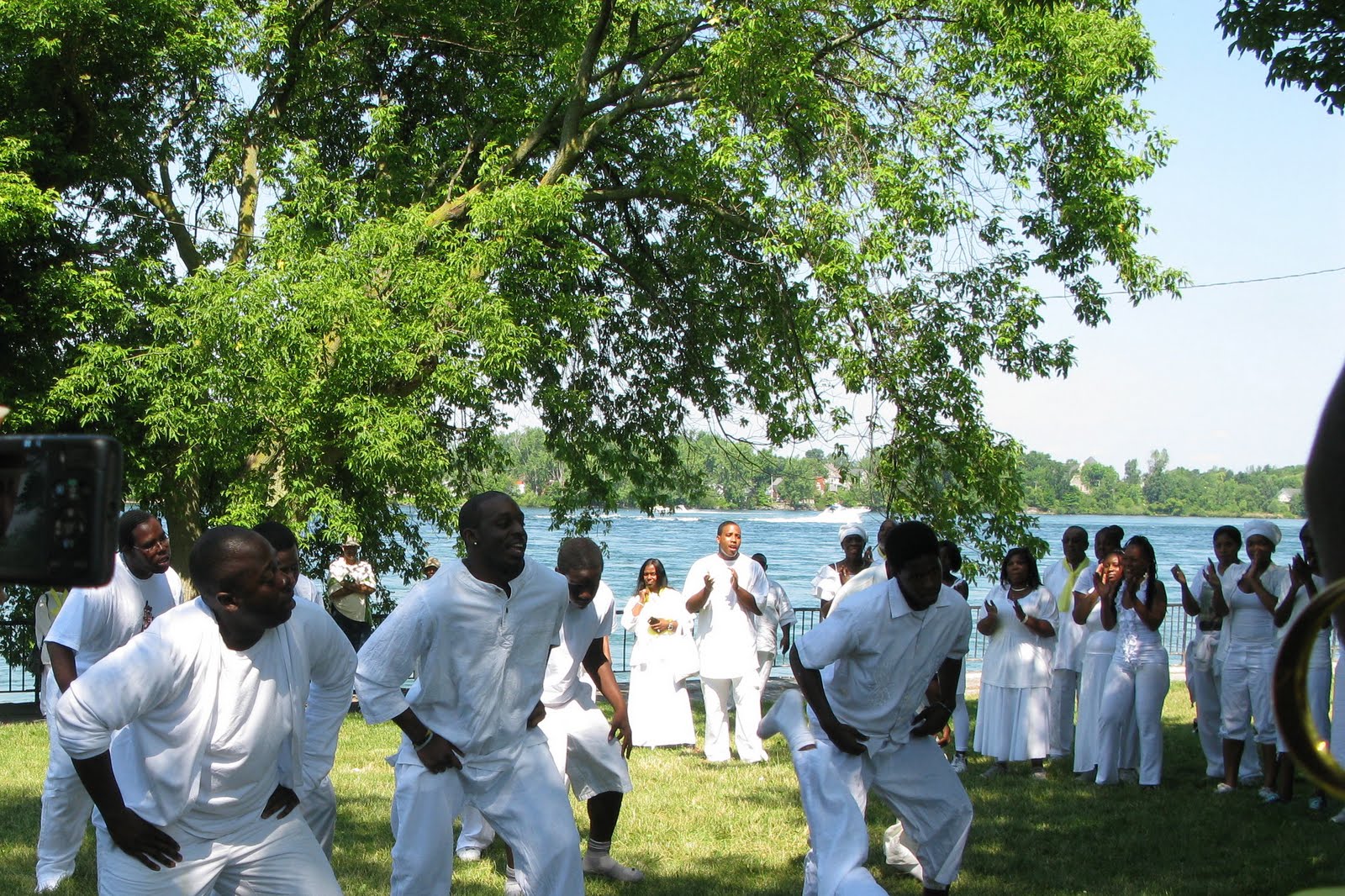
Yesterday 150 members of St Paul Community Baptist Church of East Brooklyn, NY came to Broderick Park in Buffalo for a MAAFA Healing Ceremony.


The purpose of the MAAFA Commemoration is a spiritual experience aimed at healing our collective memories and building community reconciliation. The residuals of enslavement and racism are a part of our historical landscape. The MAAFA SUITE…A Healing Journey®, a powerful psychodrama, is the beginning of a healing and educational process related to an overlooked chapter of history that has affected people of all races and cultures, and a means of increasing our awareness of and efforts to undo institutionalized racism.


A healing service was held to remember the ancestors and to honor their memory.
MAAFA (pronounced MAH-AH-FAH) is a Kiswahili word that means great calamity, catastrophe, tragedy or disaster. It was introduced into contemporary African American scholarship by Dr. Marimba Ani to redefine the period in world history formerly identified as the Middle Passage or Trans-Atlantic Slave Trade. The Commemoration of The MAAFA involves memorializing and honoring the millions of Africans lost in the horror of this nightmare.


The location is situated within easy view of the Peace Bridge, which links the State of New York with the Canadian Province of Ontario at Fort Erie. In former days the transport was small private boats provided by many who put their own lives at risk in order to help Harriet Tubman who led the runaways into Canada.

“Moses” is coming! You’ve heard the stories about her. Harriet Tubman, a former slave who ran away from a nearby plantation in 1849 but returns to rescue others. Guided by her “visions,” she never lost a passenger. Even if Moses can’t fit you into her next group, she’ll tell you how to follow the North Star to freedom in Canada.


It took courage, luck, help, and incredible stamina. Once in Canada, they could finally breathe free. Not only did the government not return you to slavery in the United States, but you could vote and even own land. No wonder thousands had already run away to settle here. There were still challenges: finding a home, making a living, adjusting to a new place.


The dancers sing and tell the story to help people understand the nature of the oppression inflicted on generations of Africans in America.


The men, women and children perform traditional joyful dances from Africa


*****

Three of the 35 Underground Railroad sites are in Western New York. They are the Michigan Street Baptist Church in Buffalo, a legendary Underground Railroad station; Murphy Orchards in Burt, where, for more than 20 years, the McClew family sheltered escaped slaves before moving them to the next station; and the Root House in Pekin, home of abolitionist Thomas Root, which was one of the last stops on the railroad. From here, in the 1850s, formerly enslaved people were transported to the Canadian border hidden in farm wagons full of produce.

The Underground Railroad, largely forgotten and ignored by history, has resurfaced in the past decade with the increased interest in heritage tourism. The far-flung Underground Railroad was a unique cooperative effort among blacks, whites and Native Americans; males and females; rich and poor; Northerners and Southerners.

If you are interested in learning more about the Underground Railroad in the Buffalo area there are tours that include the Michigan Street Baptist Church in Buffalo; the Thomas Root Home, a major stop on the Underground Railroad; and the Erie Canal, which played an important part of the road in New York.

*****

Thank you to the visitors from St. Paul Community Baptist Church in East Brooklyn NY who came to Buffalo to give honor to the ancestors who travelled these paths. Your service was beautiful and a moving experience for those who were able to watch.


Saturday, May 7, 2011

Today is National Train Day - 2011


The Southwest line travels from Waterloo, London to Bournemouth, England


A typical freight train in the United States

Today is National Train Day - 2011

Those who know me well know that I love to travel by train whenever I can. I sometimes think that I was born in the wrong century because I still have the nostalgia of train travel which developed when I was a child, and to be honest I have never felt the desire to rush from place to place :-)

Just this Tuesday I took a one day return ride on the the train from Buffalo, NY to Albany NY - a six hour journey each way - I was so happy to view the countryside just as the leaves are just appearing on the trees and the flowers are blooming. It is a wonderful route that travels through many towns and an excellent way to view the many bridges, and scenery that New York offers.

A young passenger in front of me was talking on his cell phone and I heard him say that he had never been on a train before and he was really enjoying it. He told his friend that it is just like being on an airplane except that the windows are much bigger and there is more opportunity to walk around. I thought that was an insightful observation.

As I was reading the complimentary magazine provided by Amtrak, I noticed the articles advertising information about the upcoming National Train Day and that it is on May 7, 2011 – today.

What Is National Train Day? It is a day for train lovers to celebrate the existence of trains. There are official Train Clubs; I have a friend who travels all over the world just to experience riding a certain train in a certain country. No, I do not sit at the train stations and record which trains I have viewed or travelled on in a Train Spotters Journal but I do think that I could get drawn into that hobby if someone invited me to do so.

Here is a condensed history of trains in the United States written by Amtrak. On May 10, 1869, in Promontory Summit, Utah, the "golden spike" was driven into the final tie that joined 1,776 miles of the Central Pacific and Union Pacific railways, ceremonially creating the nation’s first transcontinental railroad. And America was transformed.

Suddenly, the country was united in a way it never had been, and train travel sparked imaginations in small towns and big cities, among folk who desired adventure and businessmen who saw fortunes to be made. The sound of a train whistle was the soundtrack of happy reunions and tearful farewells. It heralded the arrival of mail, supplies and change.

The train became more than the go-to mode of transport for people and goods. It was a proud achievement of engineering vision, technical ingenuity and sweat. It was a cultural force that sparked the creative imaginations of storytellers in songs, movies and novels. Railways provided jobs for thousands of Americans. The train station became a focal point of every community, from New York City’s Pennsylvania Station to the tiny stations that dotted rural America.

Now, 140 years after the “golden spike” connected east and west, there’s never been a better time to take the train. Huge crowds and the frustrations that go with them burden our highways and airports. And at a time when we all share the same pressing concerns about environment and energy conservation, trains are a more energy-efficient mode of travel than either autos or airplanes. Riding the rails is not only a great way to reduce your carbon footprint, but also a great way to meet interesting people and see breathtaking scenery.

That’s why, in commemoration of the anniversary of the day the "golden spike" was driven, they celebrated the first-ever National Train Day on May 10, 2008. Thousands enjoyed live entertainment, train displays, raffles, prizes and surprises for big and small across the nation.
This year the events will be even better. Today there will be a coast-to-coast celebration of the way trains connect people and places, with major events in Washington, DC, Philadelphia, Chicago, and Los Angeles, while other events will occur in smaller markets nationwide. Join us and discover the Rail Way during any of the National Train Day festivities that are sure to be a treat for all ages.

To find out what activities may be happening to celebrate National Train Day in your area go to: http://www.nationaltrainday.com/2011/events

As I write this I realize that I could spend hours on this subject, especially about the immigrants who came to the United States (some voluntary and some enslaved) who laid those original tracks so that people could travel this vast country. I will save that story for another day.

I am off to my local train station to join in the fun – why not join me?

peacesojurner