Showing posts with label Poverty. Show all posts

Friday, March 30, 2012

'Bread and Roses' strike in Lawrence, Massachusetts


Bread and Roses

As we come marching, marching in the beauty of the day,
A million darkened kitchens, a thousand mill lofts gray,
Are touched with all the radiance that a sudden sun discloses,
For the people hear us singing: "Bread and roses! Bread and roses!"
As we come marching, marching, we battle too for men,
For they are women's children, and we mother them again.
Our lives shall not be sweated from birth until life closes;
Hearts starve as well as bodies; give us bread, but give us roses!
As we come marching, marching, unnumbered women dead
Go crying through our singing their ancient cry for bread.
Small art and love and beauty their drudging spirits knew.
Yes, it is bread we fight for -- but we fight for roses, too!
As we come marching, marching, we bring the greater days.
The rising of the women means the rising of the race.
No more the drudge and idler -- ten that toil where one reposes,
But a sharing of life's glories: Bread and roses! Bread and roses!

By James Oppenheim, published in American Magazine in December 1911

The poem above was written as a tribute to the women who conducted a strike in 1911, in Lawrence, Massachusetts.

In 1905 the American Woolen Company built the world's biggest textile plant in Lawrence, hiring Arab, Russian and East European immigrants. By 1911, people of 25 different nationalities lived within a one-mile radius of the mill.

They lived in crowded company-owned tenements. Eight to 10 people from different families shared one living space. Whole families--including children under 14 years old--worked in the mills. The mills were hot and humid. The work was fast paced, with high accident rates.

Rickets were common among children for lack of milk. Nearly half died before they were 6 years old. Over one-third of the mill workers died before age 25, mostly from tuberculosis and other respiratory illnesses.

Jan. 12 was the start of the 1911 'Bread and Roses' strike--one of the most significant struggles in the history of the U.S. working class--in Lawrence, Mass.

A new state law had reduced the work week from 56 to 54 hours. A small gain for workers? Sounds like it. But of course the bosses found a way to gain the advantage. They speeded up the looms and cut the average wage of $6 a week--a last straw for workers living on the edge of starvation.

Some 23,000 people left the mills and poured into the streets in protest.
The Lawrence strike broke new ground in two ways. Women led it. And there was a conscious effort to unite workers of all nationalities. Every union meeting was translated into 25 different languages.

There were four demands: a 15-percent wage increase, a 54- hour work week, double pay for overtime, and rehiring of all strikers without discrimination. The strike drew national and international publicity, and donations began to pour in.

Two months later on March 14, the strikers won a 25-percent raise for the lowest-paid workers and smaller increases for higher-paid workers, time-and-a-quarter pay for overtime, and no discrimination against strikers.

The strikers wanted not only decent pay, but a chance to enjoy the good things of life. They carried signs saying, "We want bread and roses too!"

The women who participated in this strike had the courage to stand up for their rights and their actions made a difference in the future of industrial workers.

They shaped the future of this country and this reinforces for me that notion that if one is aware of injustice then the right thing to do is to speak up against it and let those in power know that it is not acceptable. These women were among the forerunners of equal rights.

The photos above show women of the day working in the factory and also, those on strike being confronted by the National Guard.

During this month we have taken time to celebrate Women's History Month and we give honor to those brave women who have gone before us.

peacesojourner


Thursday, March 22, 2012

World Water Day - 2012


Today, March 22, 2012, is World Water Day

Most of us have always had access to running hot and cold water and could not imagine life without it. The following paragraph is an excerpt of an article I wrote when I lived in El Salvador, Central America, some years ago.

“I am living in a small room (6’ x 6’) in the local church. I have no TV, no radio, no sink, no phone, and no fridge. Actually, I do have a sink but it is outdoors and I use it to wash clothes and dishes and to store water in daily for use during the times when there is no water available. We do have water on this street but only from 7 am to 11 am every day. (4 hours) and that is not guaranteed. It is actually very liberating washing the body, the clothes and dishes (not at the same time) outdoors in the sunshine. :-) The sink is called a pilar and is very important to the way of life here. One learns to adapt very quickly and as soon as the water is turned on in the morning I hurry to get the very cold water, wash, and get ready for the day.”

While in El Salvador I witnessed many things related to water. I was in a small village outside of Santa Ana and most of the people had no running water. There was a very small waterfall at the end of ‘la linea’ (the railroad line) and the women would bathe there. Washing their hair and showering with their clothing on, while washing their dress at the same time. Then, still wearing the clothing, let it air dry in the sunshine. After this they filled large containers with water and carried them on their head to their homes.

The next village over was Masacua, and all of the people shared one water pump in the center of the village. Later, another more modern water faucet was installed (still only one for the whole village). The entire community turned out for the blessing of the water – giving thanks to God that they finally had clean running water from a deep well. There were no toilets in Masacua at the time I arrived there and a few months later some young men came from Belgium and installed some raised toilets – one for each family. The villagers would chuckle because the toilets were built up high and one had to walk up about eight cement steps to reach it - they were flushed with chemicals and a bucket of water. They named them the ‘tronos real’ (royal thrones).

I witnessed the factories from the United States pumping chemical waste into the local rivers which turned the water dark brown. No concern was given that this was the water that the local people had to drink. I agonized over the fact that in the United States they had to follow environmental safety laws and in Central America there are no such laws and the local children are dying from the contaminated water. I complained loudly to the companies but no one listened. I still feel that if the companies know that their product pollutes the water then they have a moral responsibility to put precautions in place.

In the first weeks that I was there I became very ill from drinking the water and after about two months I decided I would buy bottled water so that I would not get sick again. I'm sorry to tell you that the local people did not have the option to do that and I felt uncomfortable about it but I decided that in order to be effective in my work there I needed to stay healthy.

There was a very ingenious local water site that the men had built. There was a small river in the town from which the men had channeled the water into a swimming pool where the children could play, and the same water was again channeled into about 50 stone community sinks where the women would come and wash their clothes. The wastewater from the sinks was then directed back into the flow of the river. The women would place the clothing on the bushes along the river so that they could dry in the sunshine.

Another common sight was to see men washing daily at a public stone pilar (sink) along the side of the road on their way to work.

I had heard from the women that Health workers from other countries had come to the village to teach the women about the basic hygiene of washing their hands after everything that they do, to prevent the spread of germs. The women explained to me that they felt this was ridiculous as the one heavy container of water that they carried home daily could not be wasted on repeated hand washing.

I could give many more examples. One thing that I learned personally was to value water and when I returned to the U.S. I became very frugal with the use of water. So much so that one day the local Water Department made a visit to my home because they were sure that the water meter must not be working. My bill for several months was only $7. I explained that I had learned how to conserve water while living in Central America. They found it hard to believe but found nothing wrong with the meter. :-)

Friends, according to the United Nations, about 1.4 billion people lack access to clean water and 2.4 billion people lack adequate sanitation. Because of this, over 9,000 children die daily. Please check out the United Nations website to see what you can do to help.

peacesojourner

Thursday, December 1, 2011

Today is Bloggers Unite - World-Aids-Day


The origin of AIDS and HIV has puzzled scientists ever since the illness first came to light in the early 1980s. For almost thirty years it has been the subject of fierce debate and the cause of countless disagreements, with everything from a promiscuous flight attendant to a suspect vaccine program being blamed. So what is the truth? Just where did AIDS come from?

The first recognized cases of AIDS occurred in the USA in the early 1980’s. A number of men in New York and California suddenly began to develop rare opportunistic infections and cancers that seemed stubbornly resistant to any treatment. At this time, AIDS did not yet have a name, but it quickly became obvious that all the men were suffering from a common syndrome.

The dominant feature of this first period was silence, for the human immunodeficiency virus (HIV) was unknown and transmission was not yet understood. By 1980, HIV had spread to at least five continents (North America, South America, Europe, Africa and Australia). During this period of silence, the spread was unchecked by awareness or any preventive action and approximately 100,000-300,000 persons may have been infected.

In June 1981 the Center for Disease Control (CDC) published a report about the occurrence, without identifiable cause, of rare lung infection Pneumocystis carinii pneumonia (PCP) in five men in Los Angeles. This report is sometimes referred to as the "beginning" of AIDS, but it might be more accurate to describe it as the beginning of the general awareness of AIDS in the USA

Because there was so little known about the transmission of what seemed to be a new disease, there was concern about contagion, and whether the disease could by passed on by people who had no apparent signs or symptoms.

In 1982 we had a family friend who was diagnosed with AIDS. At that time it was a very new disease and no one knew what it was or how you got it, however, it was rumored was that it was a definite death sentence.

Norman was an entertainer, a dancer who also belonged to a local singing group. He was gentle and kind and a lifelong friend to several people. When he was diagnosed he was told that he was going to die and his mother opted to take him to her home. At that time it was an enormous secret if a person had AIDS because no one knew if it was an airborne disease or not. We, his friends, had several discussions about just how supportive we could be without putting ourselves, and our families at risk.

Norman’s birthday was approaching and one of our group, Bernard, insisted that we should give Norman a surprise birthday party. We wanted to go to visit him but we were still cautious. We tried to find out everything that had been printed about the illness. Well we discovered that it was not airborne and that we could not get AIDS from being in Norman’s presence. Bernard purchased a beautiful birthday cake and we purchased paper plates and napkins along with plastic forks and spoons. We knocked on his mother’s door and enthusiastically announced our arrival by singing “Happy Birthday To You”. He was so frail and weak but he managed a giant smile and we spent the afternoon with him. The men who were members of his singing group serenaded him with songs and even did a few dance steps. It is still a ‘happy memory’ day.

The acronym AIDS was suggested at a July meeting in Washington, D.C., AIDS (Acquired Immune Deficiency Syndrome) was first properly defined by the CDC in September 1982, and they published their first set of recommended precautions for health-care workers and allied professionals designed to prevent AIDS transmission.

Still very little was known about transmission and public anxiety continued to grow.

In 1983 it was reported that the cause of AIDS was unknown, but it seemed most likely to be caused by an agent transmitted by intimate sexual contact, through contaminated needles, or, less commonly, by inoculation of infectious blood or blood products. No evidence suggested transmission of AIDS by airborne spread.

In October, the first European World Health Organization (WHO) meeting was held in Denmark. At the meeting it was reported that there had been 2,803 AIDS cases in the USA. By the end of the year the number of AIDS cases in the USA had risen to 3,064 and of these 1,292 had died. Our friend Norman was included in the list of persons who died in 1983.

Our friendship with Norman led me to become an advocate for people living with HIV (Human Immunodeficiency Virus)/AIDS. I started a support group for teenage children whose parents had died from, or were currently living with, AIDS. These young people could not talk about it to their school friends and were stigmatized by society. The peer group gave them an opportunity to talk it over with some other young people.

The story I related to you happened 29 years ago and I am sorry to say that there is still an enormous stigma that is born by people who are infected or affected with HIV/AIDS. The statistics today are heavy and many people remain ignorant of the disease.

The death toll since the epidemic began in the early 1980s has reached 22 million, including at least 4.3 million children. More than 36 million people worldwide are now living with HIV/AIDS and every month an additional 440,000 people become infected. Approximately 95% of AIDS cases are in the developing world.

HIV/AIDS rivals poverty and war as a threat to the lives of millions of children in the developing world. There are many worthy organizations worldwide that are working towards a cure. I recommend that you to look them up online and see if you can help in some way.

I urge you to learn more about this disease and at the very least, give a person living with HIV/AIDS a smile and a hug. Yes, human contact is important to let a person know that you care.

I have lived in different countries around the world where I learned that education and medications for HIV/AIDS are not available to everyone for a variety of reasons.

This year, on World AIDS Day is is important to support universal access and human rights. Access for all to learn about prevention, treatment, care, and support is key to conquering HIV/AIDS, and is a fundamental human right.

Wont you give it some thought and then make a decision about how you can help in some small way? Please!

peacesojourner

Saturday, November 19, 2011

Did you know that today is World Toilet Day?

Did you know that today is World Toilet Day?

I am guessing that most of you reading this have lived your entire lives with access to indoor plumbing and a working toilet.

I am also aware that some of my readers may still not have running water or a flushable toilet in their home. While many of us take for granted that we will always have daily access to a bathroom there are millions of people in many developing countries who are denied this basic need every day.

You're probably wondering: Do we really need a National Toilet Day? The answer is yes. It is a day set aside to try to bring awareness to people around the world.

A group called ‘Water For People’ supports long-lasting solutions that empower communities to solve their own sanitation problems. They have asked bloggers to talk about this topic today so I am glad to do so.

Even thought at first glance World Toilet Day may seem frivolous there are activists in Washington D.C and around the world who use this day to call for increased access to basic bathrooms for everyone.

A toilet is actually a luxury in many areas of the world. Lack of toilets can spell trouble in the form of contaminated water and the spread of diseases such as cholera. Our friends in Haiti lived this experience this past year - 1,180 have died so far. The huge humanitarian operation in Haiti appears to be losing the battle against the latest catastrophe occurring in the poor Caribbean nation. 20,000 people have been treated in hospitals for the diarrheal disease, which can kill in hours through dehydration if not treated quickly.

It is estimated that 2.5 billion people worldwide do not have access to clean toilets and make do by using plastic bags or hustling off into the bushes.

Educate yourself about the lack of sanitation in the world. The facts are staggering - it is the world's biggest cause of infection. Safe disposal of children's feces leads to a reduction of nearly 40% in childhood diarrhea.

What percentage of the world uses toilet paper? The answer is: 30% –alternatives for the other 70% include hands, water, sand, small rocks, mud, leaves, rope, seaweed and corn husks.

So, when you sit down on your throne today, keep in mind that this is a day to remember that not everyone has the same ability to do what you’re doing. Not having a toilet would be like camping outdoors in the woods your whole life, don’t you think?

When I lived in El Salvador I met people in the rural communities who did not have electricity, running water or indoor plumbing. They dug out an open pit in the ground to dispose of fecal waste and when it was almost full they would cover it in with soil and then dug out another. In one community that I spent time in, some Dutch volunteer workers had built each family a raised commode (with a door) outside of the home which was built up high on cement cinder blocks. One had to go up several steps to use the commode and the waste would fall into a chemical filled site below. The villagers laughed and said that they now had royal thrones.

I once attended a gathering in the village where the local pastor conducted a religious service of thanking God for the gift of access to running water. Every villager was in attendance to give thanks to God and to witness the blessing of the water. The same volunteers from Holland had dug for water and it was finally being channeled into a pipe and one faucet. This single outdoor faucet was for the entire village to share. Before the installation of this faucet the villagers had to travel long distances to collect water and carry it in containers, balanced on their heads, back to their homes.

I also witnessed similar conditions in rural India, especially in the Dalit (formerly known as the Untouchables) community.

So there you have it - World Toilet Day is a day marked to make us aware that over 2.6 billion people in other countries across the globe do not have basic sanitation, causing widespread diseases and deaths every day.

Some may pooh-pooh the whole idea – yes, I said it :-) but really, why not stand up so that others can sit down this World Toilet Day!

******

1 out of 5 children die of diarrheal disease, which means the mother in this photo can expect to bury at least one of her children before their 5th birthday.

*****

To learn more about this go to - http://www.worldtoiletday.com

UNICEF is also committed to improving toilet and sanitation conditions worldwide.

Why not volunteer to help with labor or a financial donation? Check them out.

peacesojourner


Sunday, October 16, 2011

UN World Food Day - October 16th.


"I have the audacity to believe that people everywhere can have three meals a day for their bodies, education culture for the minds and dignity, equality and freedom for the spirits."
Martin Luther King Jr.


Today is World Food Day

Which is held annually on Oct. 16 to commemorate the founding of the United Nation's Food and Agriculture Organization (FAO) in 1945.

The program is aimed at leaders of political and non-political organizations at all levels and at increasing press attention on topical issues around food supply. Across the globe, many different events are organized to raise awareness of problems in food supply and distribution.

I have never gone to bed hungry – have you?

There have been days when I didn’t know what was going to be available to eat but there was always something on hand. Maybe a baked potato, beans on toast or fruit.

I have been in countries where I personally witnessed the hunger of the people. I lived in a village in El Salvador, where food was provided to a few by the Canadian Food Program. They made dried corn (for tortillas), and dried beans available to the families and this was their every day diet. Occasionally rice was available and was considered a luxury. Each family received the same portions, which were meticulously shared. The water was also contaminated with chemicals from local (US) factories in this particular area and many of the children were ill and dying.

In India, I lived for a while in the Dalit community (formerly known as the Untouchables). All of the people were extremely thin and the children were hollow eyed. In that community they were eating potatoes and cauliflower when that was in season. The water was also contaminated in that area.


The United States has adopted a 3.5 billion dollar plan to fight world hunger as part of 20-billion-dollar pledges made by the world's richest nations at a Group of Eight meeting in Italy in July of this year.


The United States Department of Agriculture is currently working with several organizations to improve agricultural technology use and productivity in Africa and other poor regions in order to promote hardier crops for healthier people.


Meanwhile at home, USDA's food and nutrition programs are helping to feed millions of low-income Americans. Thanks to increased funding, more children are receiving free or reduced-price breakfasts and lunches, more mothers and infants are receiving nutritional assistance and nearly six million more people are receiving food stamps than five years ago.

Now that I live in the United States I currently volunteer with three local food programs where it is evident to me that the need has increased and that even more people are in need of food. The three programs are independent of each other and at each one the number of people who line up for food has increased. Don’t let the size of some people fool you either, often the adults and children are overweight due to extremely poor nourishment and nutrition with starches being their main source of food.


*****

Children are the most vulnerable to nutritional deficits and the first to succumb when there is not enough food to go around. The Government of Ethiopia estimates that 75,000 children under the age of five live with severe acute malnutrition. And 25 to 50 percent of children with severe acute malnutrition are likely to die if they don't receive proper treatment.

Bringing international attention to the plight of these children and the benefits of the therapeutic feeding programs can help save lives!

How can you help?

* Write a post on your blog or profile page about the conditions in Ethiopia.

* Explain to your friends and family, book group or social club how malnourishment is affecting Ethiopian children.

* Send this pledge to at least five friends so they can keep spreading the word!

*****

One sixth of the world’s population goes to bed hungry.

What are you doing to help?


*****

"Never before has man had such capacity to control his own environment, to end thirst and hunger to conquer poverty and disease, to banish illiteracy and massive human misery."
John Fitzgerald Kennedy


Tuesday, January 18, 2011

'Mother of Mothers' - A Poem to the Mothers in Haiti

photos from AP


Mother of Mothers


When a brave woman's out walking
she's Mistress Life's spitting image
(Michel-Ange Hyppolite)

The faces of mothers of mothers,
their cheekbones gleaming against
taut skins; their eyes glazed
with the scarring of so much loss.

In Haiti, the mothers
of mothers have lamented for so
long—all that is left is the
sturdy presence of grace,
the wide open heart of knowing
how much a casket weighs, how
it feels on the open palm.

The mothers of mothers
march through the congregation
while the children of men
clap their hands, beat
tambourines, scratch the grater
and sing the flat harmony
that shivers the air.

Beneath a cascade of flame yellow
and red flamboyants,
she stalks the outskirts of the
feet worn worship ground—
the outer limits of the congregation
where the weeds and stones
have accumulated, here, where
the excavation of rubble takes
us as far as weary arms
and the creaky wheel barrow
can go.

These women draw a pattern
of circles with their heavy planted
feet, their arms raised high, their
voices continuing with greater
ceremony and occasion;
that conversation that began
with Jesus at four in the morning.

Oh, the mothers of mothers
who know too well the hottest
sorrow—the broken bodies
of children, the boy who covers
a jaw full of maggots, and the
tall lanky son, whose spine
gives under the weight of concrete
before he is pulled out,
laid under the soft blue light
of a wayside clinic, waiting
to go; and quietly, with the flies
returning to his skin, he is
still, though he must wait
there until dusk, before they
notice, before a procession
of mothers leads the body out
into the night, and mother of
mother, she hears her child
wake, look around, and speak:
"How nice the air is out here,"
before he dies, this time for good.

Mothers of mothers,
in your bandana and with your
holy testament, you must
draw the line of defense
around the beleaguered souls,
and speak a torrent of curses
on the beast lurking in the shadows. – Kwame Dawes

Poet, Kwame Dawes, born in Ghana in 1962. The images from post-earthquake Haiti a year later remain hauntingly powerful, the facts strikingly sad — yet somehow, the USC professor and poet who has traveled there several times to document the aftermath among people with HIV/AIDS through poetry — finds as much hope as horror.

*****

A tribute to the mothers in earthquake torn Haiti.

peacesojourner


Wednesday, January 12, 2011

Haiti - One Year After the Earthquake- 1/12/11

Haiti

Delaware and Haiti are about the same size. Last year Haiti's population was estimated at approximately seven million. The country's demographic statistics reveal the effect of extreme poverty and an HIV/AIDS epidemic. These conditions have reduced life expectancy to 49.2 years, contributed to high infant mortality and general death rates, and slowed population growth.

Haiti's population is a young one, with 41 percent estimated to be between 0 and 14 years of age. Most Haitians are of African descent.


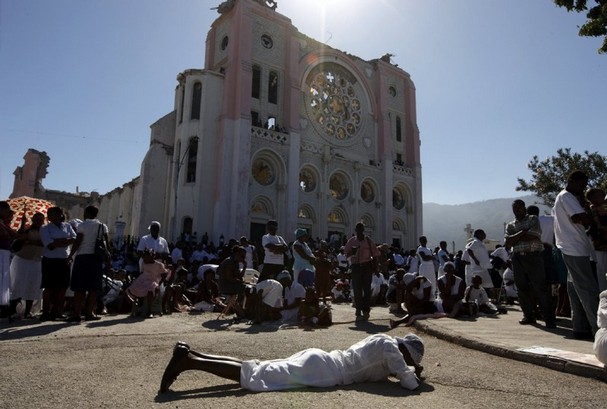
The National Cathedral - photo by David Albers

Today I heard that the people of Haiti gathered in a memorial tribute in Port au Prince, the city where so many died on that fateful afternoon one year ago. It seems that every family lost someone, a spouse, a sister, a child, a cousin or a friend in the earthquake. Haitians marched down empty, rubble-lined streets singing hymns and climbed broken buildings to hang wreaths of flowers. The nation held a minute of silence at 4:53 p.m., the moment when the earthquake ripped the ground on January 12, 2010. The government has stated its death toll estimate is more than 316,000.


Thousands gathered around the city to be with loved ones and pray. They flocked to the ruins of the once-towering national cathedral, to soccer stadium that served as an open-air morgue and later housed a tent camp, to parks, hillsides and the neighborhood centers.

Workers are still finding bodies in the rubble. Neighborhood-sized camps look like permanent shantytowns on the fields and plazas of the capital. A cholera epidemic that erupted outside the quake zone has killed more than 3,600 people, and an electoral crisis between President Rene Preval's ruling party and its rivals threatens to break an increasingly fragile political stability.


I have been wondering what it would be like to live in the earthquake portion of Haiti today. Tent camps were erected for people who lost their homes – they created little tent communities, some of them quite small, some of them very large, where an estimated one million people still live, unable to afford new homes.

If you live in a tent village with a million others what are your expenditures? No public utilities are available, no toilets, no telephones, no electricity, no running water. There is still the need for money for food and clothing.

Everyone has that desire for his or her own personal space. Many of us can seek refuge in our homes, in our bedroom. In the tent camps the living area is incredibly small, hot, constructed out of canvas and metal, and whatever else they could find. It is reported that less than 5 percent of the rubble has been cleared, only 15 percent of the temporary housing that is needed has been built and relatively few permanent water and sanitation facilities have been constructed.

The current cholera epidemic is mostly in the extreme rural areas, in the mountains and in a river valley where the outbreak began. It is heartbreaking to hear the stories of people who just weren't able to get to a treatment center in time.

This past week I watched a TV documentary about a private person from the US who took his personal 60-year-old plane and got the local people, who live on a mountaintop in Haiti, to create a landing strip for his aircraft so that he could bring medical personnel and supplies to help the people who have cholera. Many lives have been saved by the actions of this one man.

Cholera victims just need rehydration and antibiotics, and most people can be taken care of. But the problem is, so many people live out in rural areas far from treatment centers. Nearly 3,000 people have died of cholera and more than 100,000 were infected.

All of this is taking place against the backdrop of political turmoil. They had an election for president in the fall, but the results are still disputed months later. There were all kinds of allegations of fraud. There was violence in the aftermath of it that shut this city down a couple of days last month, in December.

Another problem that has surfaced is that on the day of the earthquake the local prison collapsed and hundreds of seasoned criminals escaped. There are reports that they are intimidating people and taking control of some areas. The police have been trying to round them up and have re-arrested about 700 who are being detained in a facility where there is no room for a man to lie down, so the inmates have to sleep standing up. They report that their legs are swollen and that there is a lot of fighting within the facility.

The United States and many other countries have helped to rally international support for Haiti’s recovery and reconstruction.

Over the past year, countless lives have been saved and many Haitians affected by the earthquake now have better access to food, water and health care than they did before the disaster. However, rubble continues to clog the streets, too many people are still living in tents, and for so many Haitians progress has not come fast enough. It has been said that helping the poorest nation in the Western Hemisphere recover from one of the worst natural disasters ever to strike our hemisphere will take years, if not decades.

From the slums of Port-au-Prince to the rural Central Plateau, this impoverished country continues to need assist. Right now 90 percent of the quake devastation still remains. Many people, including orphanages still live in tents and families struggle to survive on less than two dollars a day.

The bottom line is that the people of Haiti and the volunteers are living in nightmare conditions. Poverty, illness, famine, lack of adequate water, homelessness and an unstable government. But there are consistent reports of the stamina and courage of the residents who live there. In spite of their current conditions the majority maintain a sense of dignity and hope.

What to do? What to do? I don’t have the answer to that except that we should make sure that we keep ourselves informed of the circumstances in Haiti. We can contact U.S. elected officials and the United Nations to let them know that the world is watching. We can continue to support relief efforts financially or by volunteering, and for those who believe that prayer can change things – PRAY for the people of this little country who have such strong spirits and hearts.

peacesojourner