Showing posts with label Spring. Show all posts

Tuesday, April 3, 2012

Poet - Robert Browning - 'O, To Be In England.".....


O to be in England, Now That April's There

O to be in England
Now that April's there
And whoever wakes in England
Sees, some morning, unaware,
That the lowest boughs and the brushwood sheaf
Round the elm-tree bole are in tiny leaf
While the chaffinch sings on the orchard bow
In England --- now!!

And after April, when May follows,
And the whitethroat builds, and all the swallows!

Hark, where my blossomed pear-tree in the hedge
Leans to the field and scatters on the clover
Blossoms and dewdrops --- at the bent spray's edge ---
That's the wise thrush; he sings each song twice over
Lest you should think he could never recapture
The first fine careless rapture!

And though the fields look rough with hoary dew,
All will be gay when noontide wakes anew
The buttercups, the little children's dower---
Far brighter than this gaudy melon-flower!

Robert Browning 1812 – 1889

*****

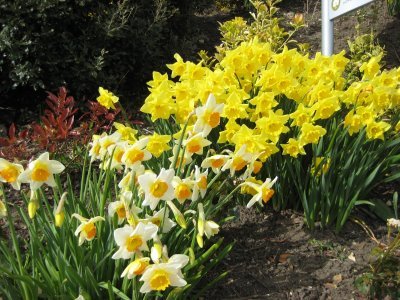
When the calendar turns the page to April, I always get a pang of nostalgia and immediately think of this poem and of England. There is truly no finer place in the world to be during the springtime. The photos above are a great example of what I mean.

Photos by permission of Maggie


Tuesday, March 20, 2012

The Vernal Equinox - Happy Spring!


Just as the crocus peeps from the ground in early
spring so new hope arises in our souls.

The spring equinox is one of the four great solar festivals of the year. Day and night are equal, poised and balanced, but about to tip over on the side of light. The spring equinox is sacred to dawn, youth, the morning star and the east. The Saxon goddess, Eostre (from whose name we get the direction East and the holiday Easter) is a dawn goddess. Just as the dawn is the time of new light, so the vernal equinox is the time of new life.

This is the start of the new year for those who celebrate the festival of Naw Ruz, Persian New Year, which falls on the spring equinox. Happy New Year greetings to my Bah’a’i friends.

Spring is here! To my friends who live in the colder climates, you will understand when I say that Spring is a time when we gladly say goodbye to the snow, ice and freezing temperatures and start to eagerly anticipate the promise of Spring. Today I can actually feel a new energy entering my body and mind as Spring starts to reveal the blossoms, the leaves on the trees, the sprouting of the crops, the mating of birds, the birth of young animals.

In the agricultural cycle, it is time for planting. We are, once again, assured that life will continue. That, no matter what devastation humans are wreaking on this earth, Mother Nature has a Master Plan that cannot be stopped.

In ancient Italy in the spring, women planted gardens of Adonis. They filled urns with grain seeds, kept them in the dark and watered them every two days. This custom persists in Sicily. Women plant seeds of grains — lentils, fennel, lettuce or flowers — in baskets and pots. When they sprout, the stalks are tied with red ribbons and the gardens are placed on graves on Good Friday. They symbolize the triumph of life over death. 


Certain foods are associated with springtime festivals: cheese, butter, eggs, pancakes, wheaten cakes, and hot cross buns. Since this is a time when young animals are being born, milk is now available for making cheese and butter. Eggs symbolize new life, of course, and wheaten cakes, grain.

Spring is a time of renewal and rebirth, a time of transition when the soul lets go of the old and plants symbolic new seeds, each year with increasing determination and renewed understanding. The warmth of the sun awakens something within us; a new quest generally begins, as if by synchronicity. More hours of daylight propel most souls to move forward, to make needed changes. It is almost an internal drive.

This is the time to symbolically choose ‘seeds’ which represent the things you want to grow during the new year-— wisdom, understanding, patience, etc. Visualize those qualities coming into full bloom in your life as you plant your seeds.

The vernal equinox has been celebrated for thousands of years. There is no shortage of rituals, celebrations and traditions, personal and universal, surrounding the coming of spring. Originally, people celebrated for the basic reason that their food supplies would soon be restored. The date is significant in Christianity because Easter always falls on the first Sunday after the first full moon after the vernal equinox.

It is no coincidence that early Egyptians built the Great Sphinx so that it pointed directly toward the rising Sun on the day of the vernal equinox.
The monoliths at Stonehenge mark the position of the rising sun on the Vernal Equinox.

In Central America the Ancient Mayan Caracol Tower and Temples of the Sun and Moon also have alignments that coincide with the sun's position on the Vernal Equinox.

In China they celebrate Chunfen on the Vernal Equinox.

Vernal Equinox Day is an official national holiday in Japan, and is spent visiting family graves, and holding family reunions.

Most of us no longer spend time outdoors, enjoying all the real things that Mother Earth has to offer. Our children sit inside our homes and watch televisions and video games which show made up fantasy programs, convincing us that either the natural world has no value, or our time is better spent elsewhere.

Open the windows and let the fresh air into your homes, sweep out all of the clutter from your closets and your mind. Take a long look at the relationships in your life and ‘clean house’ if necessary. This is a time of regeneration and new life. Let the new season that is taking place in nature take place in your own life as well.

Happy Springtime to you all!

Thursday, February 2, 2012

Welcome Imbolc

Snowdrops in bloom


IMBOLC

So the skies rumbled and the snows came, 

And everywhere down through the centuries of this gray night,

Came women gathering to pray, 

And to sink their hands into the dark earth.

They gathered seeds and prepared them for planting,

They meditated in the icy darkness,

And they celebrated the lambing of the first ewe, 

To hasten spring.

And when through the earth they felt the stirring, 

They sang songs encouraging the tiny seeds to grow.

In the dark, wet soil you can smell their work still;

They are digging along beside us. Listen!

The north wind carries their song across the snow,

This Imbolc night.

As the Earth prepares for Spring, 
Wise women gather in circles to await the promise of new life,
 And to sing praises for the green earth.

And so do we, here now, 
This year, and every year.


Welcome Imbolc!

poem by: Jill Yarnall

*****

Imbolc is one of the four principal festivals of the Irish calendar, celebrated among Gaelic peoples and some other Celtic cultures, either at the beginning of February or at the first local signs of Spring. Most commonly it is celebrated on February 2, since this is the cross-quarter day on the solar calendar, halfway between the Winter Solstice and the Spring Equinox in the northern hemisphere.

When Ireland converted to Christianity, it was hard to convince people to get rid of their old gods, so the church allowed them to worship the goddess Brighid as a saint -- thus the creation of St. Brigid's Day. Today, there are many churches around the world which bear her name.

For Christians, February 2nd continues to be celebrated as Candelmas, the feast of purification of the Virgin. By Jewish law, it took forty days after a birth for a woman to be cleansed following the birth of a son. Forty days after Christmas – the birth of Jesus – is February 2nd.
Candles were blessed, there was much feasting to be had, and the drab days of February suddenly seemed a little brighter.

Imbolc is traditionally a time of weather prognostication. Brigid is the goddess of poetry, healing and smith craft. As both goddess and saint she is also associated with holy wells, sacred flames, and healing. The lighting of candles and fires represents the return of warmth and the increasing power of the Sun over the coming months.

The holiday is a festival of the hearth and home, and a celebration of the lengthening days and the early signs of spring. It is the time of blessing of the seeds and consecration of agricultural tools. Some of the activities traditional to the festival are the lighting of candles, gathering of stones, hiking in the snow and searching for signs of spring, decorating plows, feasting, and lighting bonfires.

The festival is celebrated on February 2, and marks the midway point of winter. It is believed to have been the original source of Groundhog Day.

The promise of Imbolc is that it is the halfway point in winter. As the final line of the Imbolc poem says “As the Earth prepares for Spring, 
wise women gather in circles to await the promise of new life,
 and to sing praises for the green earth.” So that is what I will do, hum a tune and continue to look forward to days filled with flowers and sunshine. Welcome Imbolc!

*****

For those who are awaiting news of Groundhog Day, the world's most famous groundhog Punxsutawney Phil today signaled to the Inner Circle that he'd seen his shadow—meaning, according to legend, six more weeks of winter.

Including today's forecast, Phil has seen his shadow 99 times and hasn't seen it just 16 times since 1887. There are no records for the remaining years, though the group has never failed to issue a forecast.

The celebration is rooted in a German superstition that says if a hibernating animal casts a shadow on Feb. 2, the Christian holiday of Candlemas, winter will last another six weeks. If no shadow was seen, legend said spring would come early.


So, we are halfway through Winter and halfway towards Spring - hooray!

peacesojourner


Saturday, April 9, 2011

Poet - William Shakespeare - Sonnet 98


From you have I been absent in the spring... (Sonnet 98)
by William Shakespeare

From you have I been absent in the spring,
When proud-pied April, dressed in all his trim,
Hath put a spirit of youth in everything,
That heavy Saturn laughed and leaped with him,
Yet nor the lays of birds, nor the sweet smell
Of different flowers in odor and in hue,
Could make me any summer's story tell,
Or from their proud lap pluck them where they grew.
Nor did I wonder at the lily's white,
Nor praise the deep vermilion in the rose;
They were but sweet, but figures of delight,
Drawn after you, you pattern of all those.
Yet seemed it winter still, and, you away,
As with your shadow I with these did play.


Poetry:William Shakespeare

*****

William Shakespeare was born on April 23, 1564, in Stratford-on-Avon. The son of John Shakespeare and Mary Arden, at school he learned Latin and a little Greek and read the Roman dramatists. At eighteen, he married Anne Hathaway, a woman seven or eight years his senior. Together they raised two daughters: Susanna, who was born in 1583, and Judith (whose twin brother died in boyhood), born in 1585.

Little is known about Shakespeare's activities between 1585 and 1592. It is believed that he was an actor and playwright. Shortly after 1585 he went to London to begin his apprenticeship as an actor. Due to the plague, the London theaters were often closed between June 1592 and April 1594.

While Shakespeare was regarded as the foremost dramatist of his time, evidence indicates that both he and his world looked to poetry, not playwriting, for enduring fame. Shakespeare's sonnets were composed between 1593 and 1601, though not published until 1609. That edition, The Sonnets of Shakespeare, consists of 154 sonnets, all written in the form of three quatrains and a couplet that is now recognized as Shakespearean. poetry.

In his poems and plays, Shakespeare invented thousands of words, often combining or contorting Latin, French and native roots. His impressive expansion of the English language, according to the Oxford English Dictionary, includes such words as: arch-villain, birthplace, bloodsucking, courtship, dewdrop, downstairs, fanged, heartsore, hunchbacked, leapfrog, misquote, pageantry, radiance, schoolboy, stillborn, watchdog, and zany.

Shakespeare wrote more than 30 plays. Only eighteen of Shakespeare's plays were published separately in quarto editions during his lifetime; a complete collection of his works did not appear until the publication of the First Folio in 1623, several years after his death.

He died on April 23, 1616, on his 52nd birthday, and was buried two days later at Stratford Church.

Saturday, March 20, 2010

Hooray - Spring is Here - Happy Spring to you!

Hooray Spring is Here!

Happy Spring to You -

especially to my friends who live in the colder climates :-)